

[ad_1]
Like several young persons of my era, I spent an inordinate quantity of time in entrance of the television and on the telephone, commonly at the exact time. Though my grandparents could have huffed and puffed about my eyes and ears being regularly related to a unit, my regular use of these merchandise was part of how I linked with my friends and created the identities I have nowadays. It was regarded normal adolescent conduct.
Resource: Angela Patterson
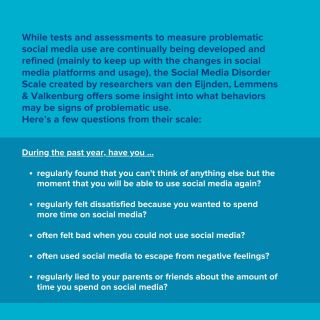
Today, teens’ repeated connection to their products and the apps uncovered on them is also regarded as standard for teens — and like anything at all, it can develop into a issue if taken up in excessive and for negative motives. In informal discussion, a person may possibly say that a man or woman is “addicted to social media,” but addiction is a advanced sickness with serious effects — this sort of a expression must not be made use of lightly. The Diagnostic and Statistical Guide of Mental Diseases (DSM) and similar manuals really do not recognize social media dependancy as a formal prognosis, so working with such a label can be deceptive. Rather, researchers generally refer to “problematic” social media use, which is exactly where a younger particular person is showing habit-like behaviors that are outside the house adolescent norms. Problematic use differs from frequent use thanks to the reduction of management that these a user activities and the danger it poses for far more critical psychological problems about time.
It can be worthy of noting that social media alone is not what can make young folks get rid of manage. In their most recent health and fitness advisory on social media use, the American Psychological Affiliation says it most effective:
“Using social media is not inherently advantageous or harmful to youthful persons. Adolescents’ life on line the two reflect and impression their offline lives. In most cases, the results of social media are dependent on adolescents’ personal personal and psychological traits and social circumstances—intersecting with the distinct information, features, or features that are afforded in quite a few social media platforms. In other terms, the results of social media very likely rely on what teenagers can do and see online, teens’ pre-existing strengths or vulnerabilities, and the contexts in which they expand up.”
This demonstrates a vital tenet of media psychology: One particular provides one’s full self to media, they interact with it, and then experience positive, destructive or neutral effects on the other facet. Social media alone — as technical platforms or as contemporary modes of conversation — does not cause everything, but could really properly tap into or enlarge something which is previously there.
This also indicates that “taking away” social media from young folks, or pushing social media corporations to control themselves and the way they join to users, will not completely remedy the issues we’re looking at with these kinds of digital connections. Section of the answer lies in adults understanding the variables that can possibly guide to problematic social media use and getting intentional steps to counteract them.
What the Study Suggests
Investigation we’ve carried out at Springtide Study Institute has discovered that youthful men and women who have trusted grownups in their lives report reduced levels of strain and loneliness and social isolation. The importance of these trusted relationships with older people aligns with some of the latest study on problematic social media use, which displays how connection to and social assist from the two friends and adults — but notably mother and father — can cut down the chance of engaging in these behaviors. This is specially true in the earlier phases of problematic use.
The internalization of particular beliefs may possibly also add to problematic social media use. Researcher Weiyu Zeng and team surveyed Chinese ladies ages 11 to 16, and uncovered that girls who experienced internalized thin-suitable photos “were a lot more vulnerable to social media’s addictive attributes, continuously engaged in selfie-related behaviors, and created subsequent problematic social media use.” But, top quality friendship served to bypass acquiring problematic social media use.
These conclusions suggest means that mom and dad and trustworthy adults can support steer youthful persons away from problematic social media use. You will find no assurance that a young particular person who has excellent relationships or develops particular characteristics will bypass struggles with social media but in obtaining them, they might be greater geared up to deal with any hardship that occurs — irrespective of whether it truly is social media or any other aspects that have the potential to be problematic. Right here are 4 concrete measures primarily based on the analysis:
- Guarantee that a youthful person is spending quality time with both of those mother and father and peers. Teens who truly feel like they have solid social aid from dad and mom have been located to report fewer problematic use. Exploration has proven that lonely teens use social media as a way to discover link, and individuals going through moderate and large amounts of loneliness have a tendency to misuse social media additional typically in contrast to people who aren’t emotion lonely. Encouraging young folks to feel bundled and connected is a strong way to head off problematic use at the pass.
- Assist younger people early on to build a perception of self-regulate. Study shows that self-command might be 1 of the personal elements that aids to decreased the chance of problematic social media use. Moms and dads can aid improvement of self-management by setting up routines and developing environments exactly where displaying self-management is regularly rewarded.
- Support youthful men and women to build resilience. Younger folks navigating hard scenarios or tough internal states could undertake unfavorable coping models like problematic social media use. When younger persons create resilience, they may perhaps have the emotions of competence and self esteem that hold them from getting into the psychological states that sometimes direct to problematic use.
- For all younger folks but women in particular — be certain that they are building healthy human body visuals and senses of self. It is widespread for younger women to begin to acquire observe of overall body picture and physical appearance norms just before they are previous sufficient to use social media. Harmful beliefs could exist just before they at any time have a profile or account. If they have a very good grasp of self-acceptance and positive physique beliefs, they’ll be improved positioned to not succumb to problematic social media use about these challenges.
Social media has a tremendous capacity to help younger individuals hook up, develop, and find out, so nutritious utilization of it ought to unquestionably be supported. And although problematic social media use can’t be absolutely prevented, mother and father and trustworthy adults can just take ways to aid younger people today use these tools without allowing merriment to switch to misuse.
[ad_2]
Supply url